Decades after Xirang, I found myself inheriting a similar system that artists of the 80s were attempting to resist. Trained in film, I accepted the idea that success followed a fixed route: festivals, galleries, institutions, recognition. At a time when my identity and voice still felt fragile and immature, the order got inverted. In-stead of whether I wanted to make work and what I made, the question became whether there was a place willing to receive it. Labels became essential to fit in somewhere. Gradually, my practice became shaped by a learned preference and the anticipation of approval.
The Wild Eighties exhibition transformed the question I was asking. Besides funding, support and visibility, why did I need permission to create? Why did certain spaces feel more legitimate than others? If space is produced rather than given, what might it mean to create one ourselves? These questions felt particularly dif-ficult to ignore and separate for me. Because as a female Asian art practitioner, a Taiwanese, space has rarely felt guaranteed. As simple as me selecting a nationality on an application form to our exhibition at the Venice Biennale as a collateral event. Many opportunities that appear straightforward for others often require de-tours. Yet ironically, my old response wasn’t to challenge these systems but to choose which ones among the intertwined colonialism, patriarchy and capitalism I felt more comfortable navigating.
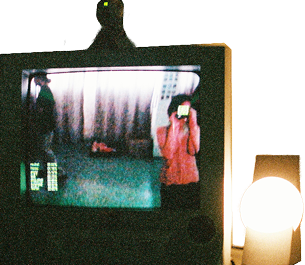
Travelling between countries, thinking in my head, writing in my room, exchanging thoughts with friends and publishing them on a journal platform I built are privileges of space. So is the ability to practise slowly and continually at my own pace.
A few years ago, this would have felt like a matter of course. I thought of space mostly as somewhere we enter: a gallery, a party, a classroom. But I have come to realise that space is not simply a container. It is produced through social, cultural and material conditions that shape how we exist, act and relate to one another. Space is practised. Family, education and society had quietly taught me how to behave within it. Museums felt sacred and required silence. Certain parties felt as though they belonged to other people. Physical or digital, space is never neutral. It is organised by power, history and habit. What feels natural is often something that has already been designed, reinforced and repeated.
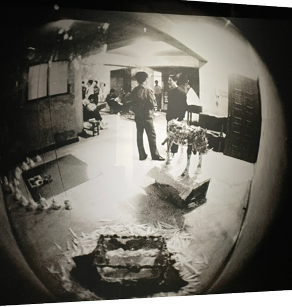
My unconscious submission was disrupted when I visited The Wild Eighties: Dawn of a Transdisciplinary Taiwan at Taipei Fine Arts Museum in 2022. I was struck by an angry, eager and collided energy I still couldn’t quite fathom, in this messy process of a terra-genesis of net-works. The art landscape of the Taiwanese 80s was outlined by the oppression of the fracturing martial law, the liberal trends in society following the rise of the economy and the influence of western culture. Artists were trying to articulate Taiwanese subjectivity and create room outside of the dominant power structures: the still rigid institution sys-tem, government surveillance and commercial galleries.
Xirang was one of them, a series initiated by artists seeking space for artistic and political expression that didn’t fit into the structures. Refus-ing to be sanitised by the government, they occupied vacant buildings and spaces and organised guerrilla-style exhibitions. Drawing on what French philosopher Michel de Certeau describes as tactical actions, Xirang seized fleeting opportunities and worked within the cracks of existing sys-tems. Working primarily in experimental and performance art, they used discard-ed objects, raw materials and their own bodies to create interdisciplinary work. The concept of space was embedded in their actions of social critique. It became critically relational, actively producing space in the structure built by the state.
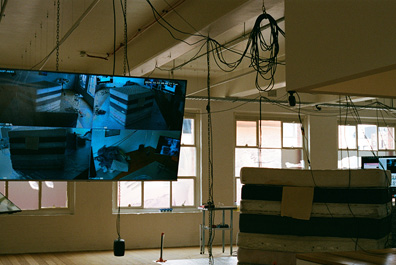
Yet no space is fully inclusive, including the ones I created. Every community develops its own cultures, pref-erences and boundaries. Queer venues, decentralised mesh networks and programs designed for marginalised groups all emerge from real needs, even as they produce new forms of inclusion and exclusion. Reading Chela Sandoval’s concept of oppositional consciousness helped me understand that recognising difference is not the opposite of solidarity. It’s not surrendering to the structures nor victimising ourselves either. Difference is of-ten the starting point of denaturalising the norm. Pretending there’s a neutral position untouched by history, identity and power is an illusion. The challenge is not to escape systems altogether, but to recognise how they shape us while continuing to negotiate space within and against them. I’m still finding my way through it.

What I have slowly come to understand is to shift the narrative from waiting for permission to building con-ditions, carrying forward the same ideology as the original alternative spaces. Not a perfect space, nor a fully open one, but a space attentive to its own limitations and capable of evolving. The word alternative is always relational. Every alternative eventually generates another alternative. Space, then, is not something we find once and for all. It is something we continue to practise in the systems we continue to queer. Through institu-tions and outside them. Through art, friendship, conversation and care. Through circles that expand from one person to another. Something organic. Sometimes radical, sometimes soft. Always in motion.


Living in Naarm introduced another perspective through artist-run initiatives and the surrounding communities. I was inspired by the care and labour involved in sustain-ing spaces for emerging voices. I felt lucky to play a small part of it and to learn from the ecology. At the same time, I sometimes felt a subtle distance between the artwork, the institution and myself. Whether that distance was pro-duced by the white cube or by my own assumptions, I be-came increasingly interested in how art might circulate and show up differently after witnessing the grassroots events happening around me. Over the past years, I have tried to explore this through event series, correspondence projects, online radio, shared meals, the journal I’m writing now and more. Through them, I hope to invite the dialogue to shift from body to work (or body with itself) to body to body.
These are modest attempts, but the ongoing practice has taught me that mak-ing space is less about constructing an alternative institution than creating conditions for exchange. The challenges are constant. Time and energy are limited since the projects are not-for-profit as well. Even for ticketed events, they sit right on the edge of breaking even because one principle I am too stubborn to compromise on is making sure artists are paid and supported as long as it’s possible, because we should. Though sustainability is something I’m still trying to navigate, the star moments rarely appear in a budget sheet. They happen when someone who rarely visits galleries encounters an artist’s work for the first time, when an artist who’s still finding their subject is given room to share, or when a conversation continues long after an event has ended. The work expands through relationships - from friends to friends’ friends and beyond.