
The sun was spicy when I walked down the street with two coffees in hand. The only genuinely hot day that summer week. Stepping into Lucian’s apartment, things softened. Browns and blacks, with a hint of green from the surrounding plants.
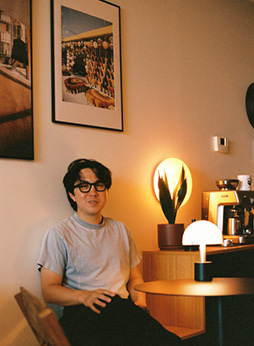
Lucian is a new media artist and researcher based in Collingwood. He also teaches game design at RMIT. The space we sat in was curated by him, with shelves built by his dad. As a fellow lamp lover, the warm light-ing already made me feel at home. We landed at the round coffee table after a house tour.
Speaking of Footscray, you presented your work The Door In Question there.
“Yes! I showed The Door In Question at Sleepless Footscray Festival. It’s an immersive XR experience directed by Troy Rainbow and a col-laboration with a massive team of other artists. The festival was funded by Maribyrnong City Council in part to activate underused spaces. The festival took over Footscray’s nightlife for a few weeks during early spring. We set up events in abandoned shopping malls and small music venues. I love the Footscray art community too. It feels a little more underground and grassroots.”
Before we go further, can you introduce XR to readers who are unfamiliar with it?
“XR is often called extended reality or cross reality. You can think of it as a spectrum of screen-based experiences. On one end, there’s virtual reality (VR), which transports you into a virtual world via a headset. On the other is augmented reality (AR), where virtual elements appear in your real space, like Apple Vision Pro. XR is about deciding whether you take someone into a world or bring a world to theirs.”
As an artist, do you have early memories that connect to what you make now?
“My mum was an art curator, so I spent a lot of time at Lake Macquarie’s Art Gallery on Awabakal Country. I did kids’ art programs like life drawing and charcoal sketching at this beautiful site because my parents had to work throughout the school holidays. That’s where I really fell in love with thinking about how to capture the environment and pay attention to sublime light. It shaped how I build virtual spaces.”
My dad was a town planner. He got me playing with Google SketchUp early on. We built these giant, sprawling mansions with different rooms. So I feel like I sit between those two practices, built environments and more traditional art forms.”
Your practice shifted from film into art-game and screen-based installation. What influenced the transition?
“I began my practice with photography, film, and animation - shooting empty scenes, and later animating 3D characters or objects into them. Being introduced to game design at uni changed everything. It freed me from linear workflows. You could be much more experimental and see results instantly.
After uni, I worked at a VR startup called Mind Flight 7, bringing VR to schools. I did some VR development for that company and other research projects at RMIT, like Beescapes. Eventually, I moved back toward screen-based games because I got so motion sick doing VR. (laugh)”
So valid haha! With your game installation, where do you usually encounter your ideas?
“Usually through random encounters, especially when I’m playing with certain technology. I’m currently doing a PhD, in which I explore games as spaces where people can have meaningful interactions with the work and get a sense of my critique by playing with different systems.
My game Check Self Out was born from using a self-checkout in Abbotsford, where they were testing the new security system a few years ago. A team member had to come over and log in when it broke down and I saw instant replay footage of myself putting the item in my basket. To see how the system actually works, where otherwise it’s often operating quite invisibly, was exciting.”
And there’s a sense of play in your work when touching on complex ideas. Where does that instinct come from?
“Humour is a big part of my projects. There’s a macabre optimism in my work. I grew up on a lot of surreal comedy like The Mighty Boosh and Monty Python. It’s a great way to break the tension and invite people into a more serious topic.”
“Monotype” is a series of conversations with artists in meaningful spaces,
offering a glimpse into their one-of-a-kind piece of mind.




Can you walk us through your creative process once an idea lands?
“I go through a phase of discovery by playing with the tools and research-ing online, seeing how I can break things or twist what already exists. I also explore other artists’ work for clarity and to make sure I’m not doing the same thing. Then I design the concept and develop.
In interactive media, play-testing is crucial. I’ll have certain goals as an artist that I want people to think about or notice. Inviting friends, artists, studio mates and even posting progress online becomes a form of testing.”
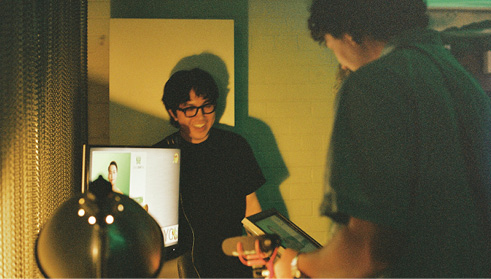
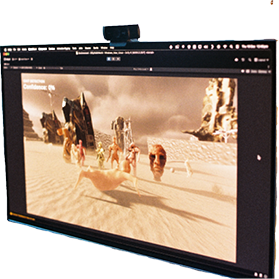
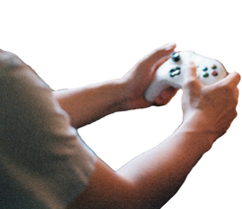
After the interview, Lucian set up a play-test. Controller in hand, I wandered around the desert curiously, switching POVs. The characters were hand-shaped and uneven. I felt the urge for the game to ask something of me. Maybe a task or a rule. I watched myself watch myself, the same reflex from the self-checkout screen: recalibrating.
I’m curious to see what shape the game takes next. And what it asks of us then. If you’re too, Lucian documents his process on his blog: https://research.rluvell.com/
The conversation took place in Yálla-birr-ang (Collingwood), on the unceded lands of the Wurundjeri people of the Kulin nation.


Can we start by saying hi to the reader?
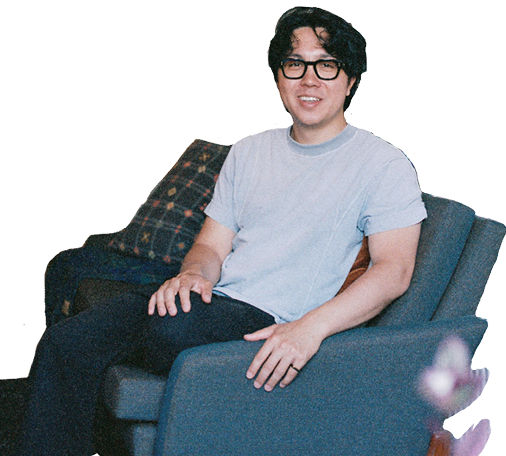
”Hi! I’m Lucian Rodriguez Lovell I’m 27, and I’m a Filipino-Aus-
tralian new media artist based in Naarm, Melbourne. Before Collingwood, which I love for its vibe and art events, I lived in other suburbs like Richmond and Footscray, and Newcastle on Awabakal Country before that.”
I relate to exploring others’ work. But sometimes, I fear of unconsciously being trapped in similar structures I admire.
“It’s really natural to find similar things. We share cultures. We will gravitate toward the same events and ideas. I also don’t think originality fully exists anymore. Everything builds on something else. We’re in this postmodern situation. But once you make something with your own touch, it’s a new original contribution to the world, regardless.”
Updating online is an interesting play-test method. I first saw Silly Walk World through your process posts. The clay models look very cute.
“This year, I really enjoyed collaborating. It’s been exciting to de-centre myself in that creative process a little bit. Less of me dictating alone in my room, more people sharing ideas. I worked with Rory Young on clay sculptures, which we 3D-scanned into characters for the game. On my current project, I’ve also been working with choreographer/dancer Geoffrey Watson, Media Artist Sam Mcgilp, and game developer Mickey Krekelberg.”
Can you tell us more about Silly Walk World?
“Silly Walk World is a world-scale simulation of a future where gait detection, the technological surveillance of how bodies move, becomes the predominant way of controlling society. Characters leave their houses and take on different walking patterns and shapes to express emo-tions, knowing they’re being read. They’re performing for the system.
In the project, we either view from the perspective of the surveillance system or as a character on the ground. You can wander through what we’ve built, the future ruins of Saudi Arabia’s Line City project.”
The idea of performing for systems feels very human. I’m interested in exploring how our actions come from imag-ining how others perceive us, or from trying to fit into society.
“Performance for sensors or surveillance is a huge aspect of my current body of work. There’s an article by Shumon Basar called The Laws of Lorecore. It’s about how, in contemporary society, we craft good narratives of ourselves that we can then sell on social media to build our aura. In Check Self Out too, as part of my embedded critique, people enjoy the work partly because they receive a printout of themselves.”
We chatted about this during my art event, when I told Lucian how popular the installation had been
Honestly, it’s true. Beyond the game being witty and fun, I found myself fixated on my image on the
screen, looking through an imagined external gaze. If I had posted about the printout afterward, con-
sciously or not, it would be partly because it added a layer of “cool” to my digital identity.
After a work is finished, how do you think about the presentation?
“I’m still learning. I think the fine art world still often turns away from art-games because they don’t fit neatly into
the mold. They’re software. It’s harder to commodify and the work doesn’t carry quite the same monetary value.
That said, Melbourne is one of the best cities for new media. I’ve shown work at your art-music event by invitation
and at the Science Gallery in ACMI through EOIs and demos. Right now, I’m looking for longer-term installations,
at least for a few weeks, where people can come and sit with the work rather than encounter it as a pop-up.”
When developing a work, where’s the hardest struggle for you - more technically, conceptually, or emotionally? Has that changed over time?
“I tend to work on things obsessively for a long time and overpack ideas. I’m learning to pull back, subtract elements and get to the core of what’s interesting for players.
The other challenge was technical ability. The need to know everything is daunting - programming, animation, art style, spatial design, etc. Through constant learning and collaboration, I’m able to experiment with bigger ideas more than before. It’s easy to replicate what’s come before, but it’s not until you actually have the agency to play with the tools that you can actually create real new experiences.”
For you, do ideas start as interaction, image, space, feeling, or others?
“I’m a concept and question-driven thinker, not quite visual. Probably because I’ve been researching a lot for the last few years, I tend to 3D-map ideas in my head, brainstorming dimensionally with things attached to them. Other times, I’m very spatial, or I flesh things out through back-and-forth dialogue and iteration.”
What other creative fields influence your work and mind outside new media?
“Food is a big one, it’s one of the ways I connect with my Filipino heritage. Photography too. I used to be really into landscape photography and now street photography. It feels like the last pure practice I have that is just for me.”
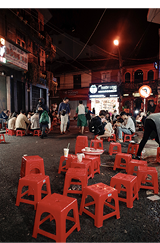
On the wall beside us were three framed prints - colourful and punchy. They’re taken on Lucian’s trip to Vietnam. The one near the entrance is my favourite: red stools outside a street food stand. Sitting by the door, it does give off the welcoming and friendly vibe he wants to deliver.
“It led to my interest in cinematography and shaped my early work. I’ve been drawn to time and capturing light through space. Those older fantasy films like Jim Henson’s The Dark Crystal and Labyrinth pulled me toward hyperrealism. I was also really into Patricia Piccinini’s work. I remember seeing it when I was very young at the Newcastle Art Gallery. I was drawn to and influenced by the kind of weird visions of the future where humans have evolved into different forms in response to technologies. Just how uncanny they are and how they can be quite unnerving to see.”
Growing up Filipino-Australian, did culture feel like something you actively carried, or something that just sat in the background?
“My mum immigrated here when she was 11 or 12. I think when she moved here, she wanted to fit into Australian culture, which created distance from her Filipino heritage. I didn’t learn Tagalog because we didn’t really speak it at home. I wasn’t around my Filipino family or community as much. I felt quite distant from it. At the same time, growing up in Newcastle, I was seen as different, as being Asian and clearly not white, or not pure enough. But still, I had some lovely friends who were accepting and open-minded. Moving to Melbourne changed that. Suddenly, I was surrounded by people from everywhere. So I feel like my most recent work hasn’t touched on it much, but I’m slowly working my way back to it.”
Does growing up that way shape how you think or make?
“Definitely, especially in the way I think. I wonder if turning to computers and games came from feeling different. One of my first major works in Year 12, a short film, explored the lost connection between nature and urban space. My culture connected those two different frictions.”
I remember you’re going to the Philippines soon. Do you see it as an opportunity to reconnect?
“Yes, for the first time with my family. This might sound pessimistic - I reckon it won’t highlight the feeling of reconnecting with my culture, but how far away I am from it.
I remember watching an interview with Jacques Derrida. He talked about the experience of being a “double-other.” He was a Jewish person growing up in Paris and was kicked out of school because of how he looked and because of his Jewish heritage. But he had no connection to his Jewish heritage nor to his Jewish family. As a Parisian, he felt that he didn’t fit. He was othered in both cases. I felt a lot of home in those words.”
As a new media artist and lecturer, what do you wish you had access to earlier in your creative journey?
“Community and space. When I finished uni, it was straight into the COVID lockdown. I felt like I didn’t know where to find other like-mind-ed artists. So it’s been a real effort the last two years to go to as many art events I could and meet people.”
Any new media art events or platforms you’d recommend checking out?
“A community that I’ve been seeing at the moment is Platform Presents. They’re running really amazing art parties and events. Also, tech-nology galleries like ACMI, especially their work-in-progress nights, where people bring their prototypes for testing. You get to see things in early stages, which can be really helpful for your own practice. It attracts a good crowd, and you can even present work there and get feedback. They call it a living laboratory.”
Advice for creatives starting their practice or academic journey?
“Letting go of your own perfectionism is a big one. Try to be confident and release the fear that the work is not good enough. To understand that any creative practice isn’t a straight line or a process that you can follow or replicate. It is a chaotic mess of figuring things out, and you need to be resilient enough to move through that turmoil. People aren’t looking at things as critically as you are.”
Are there any new goals you have set for yourself this coming year?
“I have a very straightforward goal, which is to finish my PhD. I’m trying to complete this work and find opportunities to exhibit it. Locking myself into four years of developing the same kind of ideas and projects isn’t normally the way I work, so it’s been quite challenging. I’m excited to get out of that and do some smaller projects in different fields.”
Do you design the experience upfront, or discover it through tools?
“I discover it as it reveals itself to me, following my nose. I play with things until they feel fun to me, then show them to other people to see if they care. There might be a question or a vague trajectory of direction, but I want things to take their own shape. My friend Rory, who’s a sculptor, often talks about how when he works with clay, he responds to the material through touch. There’s kind of a natural process that comes out of that. I like to think that I’m at the level of intimacy with digital technologies and game software where I connect with it.”
When you get stuck, is there a ritual that helps?
“Getting up from the seat and moving my body. We still think with our bodies, even on computers. It’s easy to forget that. I was part of a workshop where we spent the first hour every day before work with our eyes closed, crawling and moving through space.”
Through Lucian’s words, though not directly related, I’m reminded of Temporary Title by Xavier Le Roy. Bodies form and deform, composing a landscape in perpetual transformation. Their characteristics shift through time: sculptural, animal, vegetal, mechanical, or conversational. The work questions the boundary between human and inhuman, object and sub-ject, transformation and transition. Watching it, the relationship between humans and machines feels less oppositional, more entangled.
“My main mode of transport is cycling. It gets me out of the house and moving. I also go to the gym opposite the office. I think getting back into yourself and breaking the relationship between you and the computer for a little bit is important for forming a fresh perspective.”